Introduction
In the world of modern technology—where AI, cloud computing, and automation dominate the headlines—it is often the simplest innovations that quietly reshape how people move, interact, and stay safe in shared environments. One such innovation is the ExitSignMat, a technology-driven safety and wayfinding solution designed to guide individuals toward exits with clarity, reliability, and accessibility.
- Introduction
- Visibility during smoke or fire
- Crowded or fast-moving environments
- Power outages
- Accessibility concerns
- Photoluminescent Compounds
- LED-Integrated Matting
- Pressure Sensors
- Directionally Textured Surfaces
- Weather-Resistant Smart Polymers
- 1. Thermoplastic Elastomers (TPE)
- 2. Anti-Slip Rubber Composites
- 3. Low-Voltage Power Conduits
- 4. Solar-Charged Photoluminescence
- 5. Battery-Assisted Systems
- Hospitals
- Manufacturing Facilities
- Schools and Universities
- Retail and Commercial Spaces
- Airports
- Hotels and Residential Buildings
- Event Venues
- Tactile Feedback
- High-Contrast Visuals
- Low-Level Placement
- Quiet Alerts
- Maintenance
- Durability
- Compliance and Standards
- Cost
- Integration
- AI-Driven Evacuation Routing
- Dynamic Color Coding
- Integration with Wearables
- Self-Healing Polymers
- Energy Harvesting
- 1. What makes ExitSignMat different from traditional exit signs?
- 2. Does ExitSignMat require electricity?
- 3. Is ExitSignMat compliant with safety regulations?
- 4. Can ExitSignMats be customized?
- 5. How long does an ExitSignMat last?
- 6. Where is ExitSignMat most commonly used?
- 7. Can ExitSignMat support visually impaired individuals?
- About the Author
Although its name may sound like a basic floor mat with printed signage, ExitSignMat represents a sophisticated fusion of smart materials, sensor capabilities, energy-efficient illumination, and ergonomic design. It serves a purpose we rarely think about until the moment we need it: navigating safely during emergencies, blackouts, or high-traffic events.
This article takes a deep dive into the concept, evolution, functionality, and real-world applications of ExitSignMat technology. Presented in a narrative and respectful tone, it aims to highlight how such an understated device makes a profound difference in public and private spaces—from hospitals and universities to factories, retail stores, airports, and corporate buildings.
Contents
-
What Is ExitSignMat?
-
Why Traditional Exit Signage Isn’t Enough
-
The Technology Behind ExitSignMat
-
Smart Materials and Power Systems
-
Practical Uses in Modern Infrastructure
-
Accessibility and Human-Centered Design
-
Implementation Challenges and Considerations
-
Future Developments
-
Conclusion
-
Quick Bio Table
-
FAQs
1. What Is ExitSignMat?
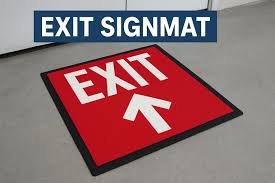
At its simplest, ExitSignMat refers to a specialized floor mat integrated with clear exit indicators, often enhanced with illumination, sensor-based activation, anti-slip textures, durable materials, and even smart technology connectivity. Its purpose is to provide a ground-level, intuitive directional guide in situations where wall-mounted signs may not be visible or sufficient.
Think of it as the next evolution of emergency signage—one that meets people where they are literally standing.
Unlike traditional signs placed above eye level, an ExitSignMat activates a person’s natural tendency to look downward while walking, especially during stressful or low-visibility situations. By designing the guidance system directly into the flooring, this technology bypasses many of the limitations of overhead signage.
2. Why Traditional Exit Signage Isn’t Enough
Traditional exit signs have served buildings for decades, but they come with limitations:
Visibility during smoke or fire
Smoke rises and fills a room from the top down, making overhead signs harder to see. Floor-level signage remains clearer for longer.
Crowded or fast-moving environments
In malls, airports, stadiums, or factories, overhead signs are often blocked by people, equipment, or architectural elements.
Power outages
Even illuminated exit signs can fail if backup power isn’t properly maintained.
ExitSignMats often integrate glow-in-the-dark material or independent low-voltage systems.
Accessibility concerns
Individuals with vision impairment may have difficulty seeing distant signs.
A tactile, floor-based system offers more inclusive guidance.
By considering these gaps, ExitSignMat fills a crucial need in modern safety design.
3. The Technology Behind ExitSignMat
The innovation behind ExitSignMat lies not in a single invention, but in the convergence of multiple technologies:
Photoluminescent Compounds
These are glow-in-the-dark materials that absorb and store ambient light, then release it gradually in low-light conditions without requiring electricity.
LED-Integrated Matting
Some versions embed micro-LEDs beneath a protective layer, providing bright and energy-efficient illumination.
They may activate automatically through:
-
Light sensors
-
Motion detectors
-
Emergency triggers
-
Building automation systems
Pressure Sensors
High-end ExitSignMats can detect foot pressure and activate illumination or send feedback to building management systems for occupant tracking or emergency analytics.
Directionally Textured Surfaces
Raised lines, arrows, and tactile bumps guide users through touch, assisting the visually impaired.
Weather-Resistant Smart Polymers
Designed for high durability in environments like industrial zones, schools, or commercial spaces.
Together, these features transform a simple floor mat into a multi-layered safety instrument.
4. Smart Materials and Power Systems
To maintain long-term performance, ExitSignMats use materials and power configurations engineered for reliability:
1. Thermoplastic Elastomers (TPE)
Flexible, impact-resistant, and ideal for high-traffic zones.
2. Anti-Slip Rubber Composites
Prevent slips, making the mat part of the safety system rather than a hazard.
3. Low-Voltage Power Conduits
For LED variants, embedded wiring runs beneath the mat with protections against moisture, abrasion, and heat.
4. Solar-Charged Photoluminescence
In some settings—such as outdoor pathways or semi-lit corridors—ambient light provides sustainable energy storage.
5. Battery-Assisted Systems
Rechargeable systems supply additional reliability in mission-critical buildings like hospitals, laboratories, or server facilities.
The combination of these systems ensures that the signage remains operational even during infrastructure-level failures.
5. Practical Uses in Modern Infrastructure
The versatility of ExitSignMat makes it suitable for a broad range of environments:
Hospitals
During emergencies, patients and staff require ground-level visual cues to navigate hallways. Mats can also assist with evacuating individuals who cannot look up or have limited mobility.
Manufacturing Facilities
Noise, machinery, and structure often obstruct wall signs. Floor-level mats remain visible even amidst industrial clutter.
Schools and Universities
ExitSignMats support structured evacuation drills and provide an extra layer of safety for large student populations.
Retail and Commercial Spaces
Mats placed near staircases, emergency doors, or long aisles streamline movement and reduce confusion in large stores or malls.
Airports
Crowded terminals benefit from illuminated flooring during power disruptions or emergency redirection.
Hotels and Residential Buildings
Placed in hallways, they can guide occupants safely at night or when the building loses power.
Event Venues
Large gatherings benefit greatly from illuminated floor-based navigation when quick crowd movement is necessary.
In each scenario, ExitSignMat enhances both safety and behavioral predictability—two essential components of effective emergency management.
6. Accessibility and Human-Centered Design
Modern safety design increasingly emphasizes inclusive engineering, and ExitSignMat plays a key role in this shift.
Tactile Feedback
Raised arrows and grooves help individuals with low vision navigate through touch.
High-Contrast Visuals
Large, standardized exit symbols allow easier recognition even for those with cognitive or visual limitations.
Low-Level Placement
Floor-level signage is particularly useful for wheelchair users, elderly individuals, and children.
Quiet Alerts
Some variants incorporate subtle vibration signals or pressure-triggered indicators that support those with hearing impairments.
This approach reflects a broader movement toward human-centered infrastructure, acknowledging diversity in physical and cognitive abilities.
7. Implementation Challenges and Considerations
While ExitSignMat offers remarkable benefits, it also comes with considerations:
Maintenance
LED-integrated mats require periodic inspection of wiring and batteries, particularly in older buildings.
Durability
High-traffic areas may wear down surfaces, requiring industrial-grade materials to maintain visibility.
Compliance and Standards
Building codes vary by region. Safety mats must align with fire regulations, ADA standards, and local emergency signage rules.
Cost
Advanced mats with sensors and lighting systems can be more expensive than basic signage, though they often reduce long-term risks.
Integration
Connecting smart mats to existing building management systems (BMS) may require technical expertise.
Despite these challenges, organizations increasingly see ExitSignMats as a worthwhile investment.
8. Future Developments
The next phase of ExitSignMat innovation is shaping up to be even more transformative:
AI-Driven Evacuation Routing
Smart mats could adjust their illuminated arrows based on real-time hazard detection.
Dynamic Color Coding
LED panels may shift colors according to building alerts—such as fire, earthquake, or lockdown procedures.
Integration with Wearables
Evacuation signals could sync with smartwatches or mobile devices for synchronized guidance.
Self-Healing Polymers
Advanced materials may automatically repair surface wear.
Energy Harvesting
Future mats may generate power from footstep pressure (piezoelectric systems).
These advancements would create a new generation of responsive evacuation ecosystems, with mats acting as intelligent nodes in a broader safety network.
Conclusion
ExitSignMat may seem like a modest piece of equipment, yet it represents a powerful evolution in emergency signage and human-centered infrastructure design. By shifting essential guidance to floor level, integrating smart technologies, and enhancing accessibility, this innovation reshapes how buildings protect their occupants.
Its value becomes most clear in moments of urgency—when visibility is low, crowds are dense, and every second counts. Whether in hospitals, industrial facilities, airports, or educational institutions, ExitSignMat plays a vital role in ensuring people find their way safely and confidently.
Simple, intuitive, and technologically advanced, it stands as a reminder that safety innovation is not always flashy—it is often grounded, literally, at our feet.
Quick Bio Table
| Feature | Description |
|---|---|
| Product Name | ExitSignMat |
| Category | Safety Technology / Smart Infrastructure |
| Primary Function | Floor-level illuminated exit guidance |
| Core Technologies | LEDs, photoluminescence, sensors, smart polymers |
| Key Benefits | Visibility, accessibility, reliability, intuitive navigation |
| Common Use Cases | Hospitals, factories, schools, airports, retail, events |
| Future Potential | AI routing, dynamic lighting, smart building integration |
FAQs
1. What makes ExitSignMat different from traditional exit signs?
It provides ground-level, illuminated guidance that remains visible during smoke, blackouts, and crowded conditions—offering a more reliable navigation method.
2. Does ExitSignMat require electricity?
Some versions do, especially LED-based models, but photoluminescent variants rely solely on stored ambient light.
3. Is ExitSignMat compliant with safety regulations?
Most models are designed to meet regional building and fire safety codes, though requirements vary by jurisdiction.
4. Can ExitSignMats be customized?
Yes. Organizations often customize materials, colors, arrow patterns, and illumination features to match building layouts.
5. How long does an ExitSignMat last?
Depending on materials and environment, high-quality mats can last several years, with LEDs rated for long-term, low-energy use.
6. Where is ExitSignMat most commonly used?
High-traffic or complex buildings like hospitals, airports, malls, universities, and industrial facilities.
7. Can ExitSignMat support visually impaired individuals?
Absolutely. Many mats use tactile textures, contrast markings, and ground-level placement to support accessibility.
About the Author