
Introduction
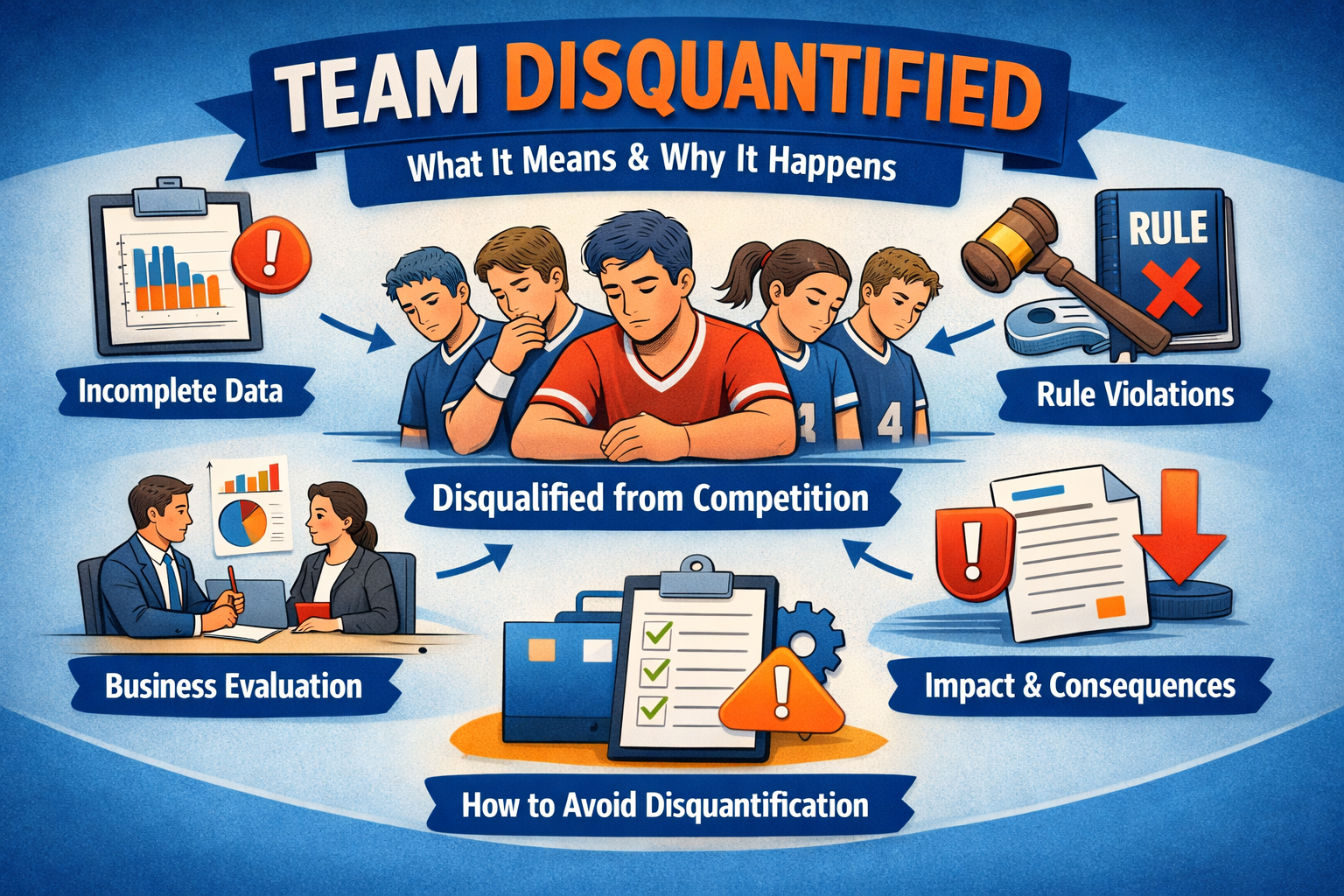
The term team disquantified is increasingly appearing in discussions related to sports, competitive events, corporate performance reviews, and even academic or technical evaluations. While it may sound complex at first, team disquantified carries a clear and practical meaning once understood in context. Many readers search for team disquantified to understand why a group was removed from consideration, how such decisions are made, and what consequences follow. This article explains the concept in detail, using clear language and real-world relevance so informational users can easily benefit from it.
What Does Team Disquantified Mean?
At its core, team disquantified refers to a situation where a team is formally removed from eligibility, ranking, scoring, or further participation due to failure to meet specific rules, standards, or criteria. Unlike simple disqualification based on a single violation, team disquantified often implies that measurable requirements were not fulfilled or that evaluation metrics could not be applied fairly.
The phrase team disquantified is commonly used when numerical data, performance metrics, or compliance benchmarks are missing, invalid, or compromised. This makes it impossible to fairly assess the team alongside others.
Origin and Context of Team Disquantified
The usage of team disquantified has grown as organizations rely more heavily on structured evaluation systems. In sports, it may relate to incomplete match data or rule violations. In corporate or project environments, team disquantified can apply when reporting standards are not met. In research or academic competitions, teams may be disquantified if required documentation or measurable outputs are absent.
As evaluation systems become more data-driven, the concept of team disquantified becomes increasingly relevant.
Common Reasons a Team Is Disquantified
There are several recurring reasons why a team disquantified decision may occur:
One major reason is incomplete or invalid data. If a team fails to submit required metrics, performance logs, or reports, evaluators may not be able to score them accurately.
Another reason is rule non-compliance. Even if performance is strong, violating predefined rules can result in a team disquantified outcome.
Technical failures can also lead to team disquantified status. For example, system errors, corrupted files, or missing records may prevent fair evaluation.
In some cases, ethical or procedural concerns arise, such as inconsistent participation or unverified results, leading to a team disquantified ruling.
Team Disquantified in Sports and Competitive Events
In sports and tournaments, team disquantified is often misunderstood. It does not always mean cheating or misconduct. Sometimes, a team is disquantified due to administrative oversights, such as improper registration, missing eligibility documents, or failure to meet minimum participation requirements.
For example, if a team does not complete the required number of matches, or if match results cannot be verified, officials may label the team disquantified to protect the integrity of rankings and outcomes.
Team Disquantified in Business and Project Evaluation
In business settings, team disquantified can occur during audits, performance reviews, or competitive bidding processes. If a team fails to provide measurable results, standardized reports, or compliance evidence, decision-makers may exclude them from comparisons.
Here, team disquantified is not necessarily a judgment of skill or effort. Instead, it reflects the inability to apply objective metrics. This distinction is important for organizations seeking fairness and transparency.
Impact of Being Team Disquantified
Being labeled team disquantified can have both short-term and long-term effects. In the short term, the team may lose rankings, rewards, or advancement opportunities. In the long term, repeated team disquantified outcomes can affect reputation and trust.
However, a single team disquantified decision does not define overall capability. Many teams recover by addressing gaps, improving documentation, and aligning with evaluation standards.
How Teams Can Avoid Being Disquantified
Avoiding a team disquantified outcome requires preparation and awareness. Teams should clearly understand evaluation criteria before participation. Maintaining accurate records, meeting deadlines, and following procedural rules are essential.
Communication also plays a key role. If issues arise, early clarification can sometimes prevent a team disquantified ruling. Teams that treat compliance and measurement as part of their strategy are far less likely to face exclusion.
Misconceptions About Team Disquantified
A common misconception is that team disquantified always implies wrongdoing. In reality, many cases are administrative or technical. Another misunderstanding is that team disquantified decisions are final and irreversible. In some systems, appeals or reviews are possible once missing data or errors are corrected.
Understanding these nuances helps teams respond constructively rather than defensively.
Why Team Disquantified Matters in Modern Evaluation Systems
As organizations move toward data-driven decisions, the concept of team disquantified becomes more significant. Fair comparison depends on consistent, measurable inputs. When those inputs are missing, exclusion becomes a practical necessity rather than a punishment.
The rise of analytics, compliance standards, and transparency frameworks means team disquantified will continue to be used across industries.
Conclusion
The term team disquantified represents more than simple exclusion. It reflects the growing importance of measurable standards, clear rules, and reliable data in modern evaluation systems. Whether in sports, business, or competitive environments, understanding why a team disquantified decision occurs helps teams prepare better and respond smarter.
By focusing on compliance, documentation, and clarity, teams can reduce the risk of being disquantified and ensure their efforts are evaluated fairly and accurately.
FAQs About Team Disquantified
1. What does team disquantified mean in simple terms?
It means a team was removed from evaluation because required rules or measurable criteria were not met.
2. Is team disquantified the same as disqualified?
Not exactly. Team disquantified usually relates to missing or invalid data, not necessarily misconduct.
3. Can a team recover after being disquantified?
Yes, in many cases teams can improve processes and avoid future disquantified outcomes.
4. Does team disquantified affect reputation permanently?
One instance usually does not, but repeated cases can impact trust and credibility.
5. Where is the term team disquantified commonly used?
It is used in sports, business evaluations, academic competitions, and data-driven assessments.
If you want, I can next optimize this article further for Google Discover, refine keyword placement, or rewrite it to match a specific niche like sports or corporate use.
About the Author